

 EMCDDA home page
European guide on health and social responses to drug problems
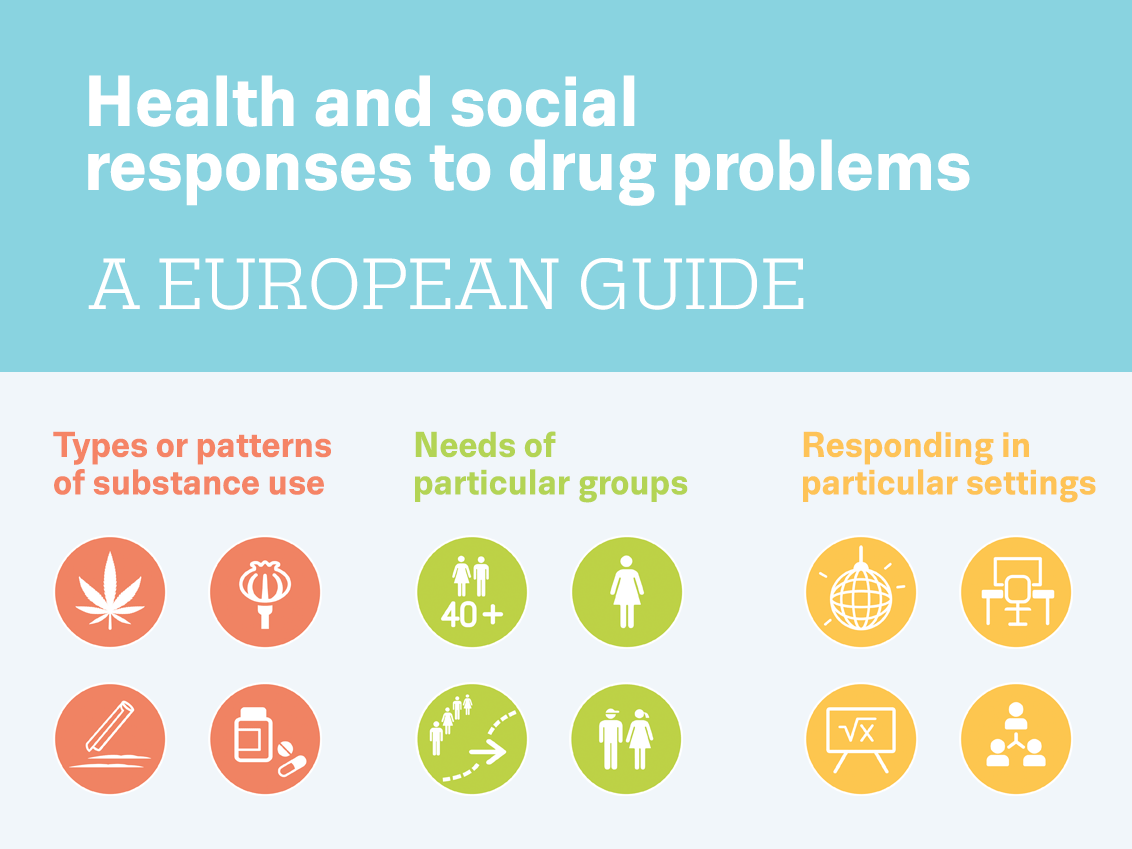
#HealthierEurope
Health and social responses to drug problems: a European guide
Health and social responses to drug problems: a European guide is designed to provide an overview of actions or interventions undertaken to address the negative consequences associated with the illicit drug phenomenon. It also acts as a gateway to a wide range of online resources, including links to evidence and tools.
Health and social responses to drug problems: a European guide
This guide and the associated package of online materials provide a reference point for planning or delivering health and social responses to drug problems in Europe. The most appropriate responses will depend on the specific drug problems, the contexts in which these occur and the types of intervention that are possible and socially acceptable. By providing key information on some of the most important drug issues for Europe and the responses available, this guide aims to assist those involved in tackling these challenges to develop new programmes and improve existing ones.
Policy and practice briefings
Each of these policy and practice briefings is designed as a one-stop-shop for anyone planning or delivering health and social responses to drug problems in Europe. Each briefing consists of: (1) a summary of the main issues; (2) the main response options; (3) an overview of the EU picture; (4) key implications for policy and practice and; (5) links to further resources. The briefings are part of the EMCDDA's Best practice portal.
Types or patterns of substance use

Needs of particular groups
Responding in particular settings
Background papers
These background papers were commissioned by the EMCDDA to provide background information to inform and contribute to the drafting of Health and social responses to drug problems: a European guide. The EMCDDA are grateful for the valuable contribution of the author. The paper has been cited within Health and social responses to drug problems and is also being made available here for those who would like further information on the topic. However, the views, interpretations and conclusions set out in this publication are those of the author and are not necessarily those of the EMCDDA or its partners, any EU Member State or any agency or institution of the European Union.
Responding to the needs of ageing drug users, Lauren Johnston, Dave Liddell, Katie Browne, Saket Priyadarshi
Drug-checking as a harm reduction tool for recreational drug users: opportunities and challenges, Tibor Brunt
User-led interventions: an expanding resource? Russell Webster
Evidence review summary: drug demand reduction, treatment, and harm reduction, Harry R Sumnall, Geoff Bates, Lisa Jones
Applying behavioural insights to drug policy and practice: opportunities and challenges, Sara Rafael Almeida, Joana Sousa Lourenço, Emanuele Ciriolo
New developments in cannabis regulation, Beau Kilmer
E-health and m-health: using new technologies to respond to drug problems, Matthijs Blankers, Ajla Mujcic
Migrants, asylum seekers and refugees: an overview of the literature relating to drug use and access to services, Paul Lemmens, Hans Dupont, Inez Roosen
Recovery, reintegration, abstinence, harm reduction: the role of different goals within drug treatment in the European context, Annette Dale-Perera
Joining up sexual health and drug services to better meet client needs, Owen Bowden-Jones
Women who use drugs: issues, needs, responses, challenges and implications for policy and practice, Sharon Arpa
Health and social responses to drug problems in prisons, Ciara Guiney
Online resources
You can find below useful online resources which are given at the end of each chapter in Health and social responses to drug problems: a European guide.
Responding to problems associated with cannabis use
EMCDDA
- Best practice portal.
- Statistical bulletin.
- Cannabis legislation in Europe, 2017.
- European drug report: trends and developments 2017.
- Treatment of cannabis-related disorders in Europe, Insights, 2015.
- New developments in cannabis regulation, Beau Kilmer, Background paper.
- Implementation of drug-, alcohol- and tobacco-related brief interventions in the European Union Member States, Norway and Turkey, Technical report, 2017.
Other sources
- Fischer, B., Russell, C., Sabioni, P., van den Brink, W., Le Foll, B., Hall, W., Rehm, J. and Room, R. (2017), ‘Lower-risk cannabis use guidelines: a comprehensive update of evidence and recommendations’, American Journal of Public Health: published online before print June 23, 2017. DOI: 10.2105/AJPH.2017.303818
- Montanari, L., Guarita, B., Mounteney, J., Zipfel, N. and Simon, S. (2017), ‘Cannabis use among people entering drug treatment in Europe: A growing phenomenon?’, European Addiction Research 23, pp. 113–121.
Tackling opioid dependence
EMCDDA
- Best practice portal.
- European drug report: trends and developments 2017.
- Pregnancy and opioid use: strategies for treatment, EMCDDA Papers, 2014.
- Residential treatment for drug use in Europe, EMCDDA Papers, 2014.
- Therapeutic communities for treating addictions in Europe: evidence, current practices and future challenges, Insights, 2014.
- Trends in heroin use in Europe: what do treatment demand data tell us? Perspectives on drugs, 2013.
- Social reintegration and employment: evidence and interventions for drug users in treatment, Insights, 2012.
- New heroin-assisted treatment, Insights, 2012.
- Recovery, reintegration, abstinence, harm reduction: the role of different goals within drug treatment in the European context, Annette Dale-Perera, Background paper.
Other sources
- WHO Guidelines for the psychosocially assisted pharmacological treatment of opioid dependence, 2009.
- WHO Guidelines for identification and management of substance use and substance use disorders in pregnancy, 2014.
- ATOME project. Final report and recommendations to ministries of health, 2014.
Reducing opioid-related deaths
EMCDDA
- Best practice portal.
- European drug report: trends and developments 2017.
- Preventing overdose deaths in Europe, Perspectives on drugs, 2017.
- Drug consumption rooms: an overview of provision and evidence, Perspectives on drugs, 2017.
- Preventing opioid overdose deaths with take-home naloxone, Insights, 2016.
- Preventing fatal overdoses: a systematic review of the effectiveness of take-home naloxone, EMCDDA Papers, 2015.
Other sources
Reducing the spread of HIV, viral hepatitis and other infections associated with injecting drug use
EMCDDA
- Best practice portal.
- European drug report: trends and developments 2017.
- Hepatitis C treatment for injecting drug users, Perspectives on drugs, 2015.
- Hepatitis C among drug users in Europe: epidemiology, treatment and prevention, Insights, 2016.
- Drug-related infectious diseases in Europe: update from the EMCDDA expert network, Rapid communication, 2017.
- Estimating trends in injecting drug use in Europe using national data on drug treatment admissions, Technical paper, 2015.
- Guidelines for testing HIV, viral hepatitis and other infections in injecting drug users, Manual, 2010.
ECDC and EMCDDA
Other sources
- UNODC, UNAIDS, WHO. Guidance relating to infectious diseases and injecting drug use (webpage).
Responding to problems related to stimulant use
EMCDDA
- Best practice portal.
- Statistical bulletin.
- European drug report: trends and developments 2017.
- Emergency health consequences of cocaine use in Europe, Perspectives on drugs, 2014.
- Treatment for cocaine dependence: reviewing current evidence, Perspectives on drugs, 2014.
- Emergency health consequences of cocaine use in Europe. A review of the monitoring of drug-related acute emergencies in 30 European countries, Technical report, 2014.
- Health and social responses for methamphetamine users in Europe, Perspectives on drugs, 2014.
- Exploring methamphetamine trends in Europe, EMCDDA Papers, 2014.
- Joining up sexual health and drug services to better meet clients needs, Owen Bowden-Jones, Background paper.
Responding to new psychoactive substances
EMCDDA
- Best practice portal.
- European drug report: trends and developments 2017.
- EMCDDA EWS reports and updates and the Risk assessment reports.
- Health responses to new psychoactive substances, Perspectives on drugs, 2016.
- Health responses to new psychoactive substances, Rapid communication, 2016.
- Injection of synthetic cathinones, Perspectives on drugs, 2015.
- New psychoactive substances in Europe: Innovative legal responses, 2015.
- Drug-checking as a harm reduction tool for recreational drug users: opportunities and challenges, Tibor Brunt, Background paper.
- New psychoactive substances in Europe: legislation and prosecution — current challenges and solutions, 2016.
Other sources
- UNODC. Global SMART programme.
- Neptune group. Neptune clinical guidance, 2015.
Addressing the misuse of medicines
EMCDDA
- Best practice portal.
- European drug report: trends and developments 2017.
- The misuse of benzodiazepines among high-risk opioid users in Europe, Perspectives on drugs, 2015.
- Strategies to prevent diversion of opioid substitution treatment medications, Perspectives on drugs, 2016.
- EMCDDA activities in the area of hospital emergency data.
- Misuse of medicines in Europe: risks and prevention, Jørgen G. Bramness, Background paper.
Other sources
- WHO. Access to analgesics and to other controlled medications.
- INCB. Availability of Internationally controlled drugs: ensuring adequate access for medical and scientific purposes. Indispensable, adequately available and not unduly restricted, 2015.
Responding to polydrug use
EMCDDA
- Polydrug use: patterns and responses, Selected issue, 2009.
- Treatment demand indicator (TDI) standard protocol 3.0: Guidelines for reporting data on people entering drug treatment in European countries, 2012.
- European drug report: trends and developments 2017.
Older people with problematic opioid use
EMCDDA
- Ageing and addiction: challenges for treatment systems, Poster, 2015.
- Treatment and care for older drug users, Selected issues, 2010.
- Responding to the needs of ageing drug users, Lauren Johnston, Dave Liddell, Katie Browne and Saket Priyadarshi, Background paper.
Other sources
- Scottish Drug Forum. Older people with drug problems in Scotland: addressing the needs of an ageing population.
Women with drug problems
EMCDDA
- Best practice portal.
- Pregnancy and opioid use: strategies for treatment, EMCDDA Papers, 2014.
- Women and gender issues in drug use, EMCDDA topic page.
- Women who use drugs: Issues, needs, responses, challenges and implications for policy and practice, Sharon Arpa, Background paper.
Other sources
- WHO. Guidelines for the identification and management of substance use and substance use disorders in pregnancy, 2014.
- UNODC. Guidelines on drug prevention and treatment for girls and women, 2016.
- UNODC.International standards on drug use prevention, 2015.
Migrants, refugees and asylum seekers
EMCDDA
- Drug prevention interventions targeting minority ethnic populations: issues raised by 33 case studies, Thematic paper, 2013.
- Migrants, asylum seekers and refugees: an overview of the literature relating to drug use and access to services, Paul Lemmens, Hans Dupont and Inez Roosen, Background paper.
Other sources
- European Union Agency for Fundamental Rights. Current migration situation in the EU: Torture, trauma and its possible impact on drug use, 2017.
- UNHCR and WHO. Rapid assessment of alcohol and other substance use in conflict-affected and displaced populations: a field guide, 2008.
- UNHCR and WHO. mhGAP Humanitarian Intervention Guide (mhGAP-HIG): Clinical management of mental, neurological and substance use conditions in humanitarian emergencies, 2015.
Vulnerable young people
EMCDDA
- Preventing later substance use disorders in at-risk children and adolescents: a review of the theory and evidence base of indicated prevention, Thematic paper, 2010.
- Multidimensional family therapy for adolescent drug users: a systematic review, EMCDDA Paper, 2014.
- Prevention of addictive behaviours, Insights, 2015.
- Treatment of cannabis-related disorders in Europe. Insights, 2015.
- Drugs and vulnerable groups of young people, Selected issues, 2008.
- Examples of evaluated practices: EDDRA.
- E-health and m-health: using new technologies to respond to drug problems, Background paper, Matthijs Blankers and Ajla Mujcic.
Other sources
Adult family members of people with drug problems
EMCDDA
Other sources
- UK Drug Policy Commission. The forgotten carers: support for adult family members affected by a relative’s drug problems, 2012.
- UK Drug Policy Commission. Adult family members and carers of dependent drug users: prevalence, social cost, resource savings and treatment responses, 2009.
Prisons and the criminal justice system
EMCDDA
- Best practice portal.
- European drug report: trends and developments 2017.
- Prisons and drugs: prevalence, responses and alternatives to imprisonment, Thematic page.
- Prisons and drugs in Europe: the problem and responses, Selected issue, 2012.
- Estimating public expenditure on drug law offenders in prison in Europe, EMCDDA paper, 2014.
- Alternatives to punishment for drug-using offenders, EMCDDA Papers, 2015.
- Health and social responses to drug problems in prisons, Ciara Guiney, Background paper.
Other sources
- World Health Organization. Prisons and Health, 2014.
- ECDC. Systematic review on the diagnosis, treatment, care and prevention of tuberculosis in prison settings, 2017.
- European Commission. Study on alternatives to coercive sanctions as response to drug law offences and drug-related crimes, 2016.
Nightlife, festival and other recreational settings
EMCDDA
- Responding to drug use and related problems in recreational settings, Thematic paper, 2012.
- Best practice portal.
- Healthy Nightlife Toolbox.
Other sources
- Nightlife Empowerment & Well-Being Implementation Project (NEWIP) standards available at http://newip.safernightlife.org/standards
- Peer education interventions in nightlife settings.
- Drug checking services.
- Safer nightlife labels and charters.
- Serious games in nightlife settings.
- IREFREA Manual: Set of standards to improve the health and safety of recreational nightlife venues.
Workplaces
Other sources
- OSHA. A review on the future of work: performance-enhancing drugs, Discussion paper, 2015.
- OSHA. European survey of enterprises on new and emerging risks, 2014.
- Eurofound. Use of alcohol and drugs at the workplace, 2012.
- Management of alcohol- and drug-related issues in the workplace. An ILO code of practice. Geneva, International Labour Office, 1996.
- Shahandeh, B. and Caborn, J. (2003), Ethical issues in workplace drug testing in Europe Geneva: ILO.
- Pompidou Group. Prevention of drug use in the workplace.
- UK Health and Safety Executive. Drug misuse at work: A guide for employers.
Schools and colleges
EMCDDA
- Best practice portal.
- Xchange registry.
- Prevention of addictive behaviours, Insights, 2015.
- Prevention profiles.
Other sources
- UNESCO, UNODC and WHO (2017), Education sector responses to the use of alcohol, tobacco and drugs. Paris: United Nations Educational, Scientific and Cultural Organization.
Local communities
EMCDDA
Launch details
Date: 24 October 2017 Time: The report will be launched online at 11.00 Central European Time/CET (10.00 Western European Time/WET, Lisbon time)
Press contact
Kathryn Robertson — Tel. (351) 211 21 02 32
Maria-José Bailey — Tel. (351) 211 21 02 40